


What is Oracle E-Business Suite?
Oracle E-Business Suite (Oracle EBS) is one of Oracle Corporation's flagship enterprise application suites. Introduced in 2001, it was Oracle's first comprehensive platform that combined Enterprise Resource Planning (ERP) and Customer Relationship Management (CRM) capabilities into a single integrated solution. The suite operates on Oracle Database and continues to be one of Oracle's most widely adopted enterprise software products.
Although Oracle introduced Oracle Fusion Applications in 2011, integrating capabilities from Oracle E-Business Suite, JD Edwards, PeopleSoft, and Siebel, Oracle continues to actively support and enhance Oracle E-Business Suite. Many organizations still rely on EBS because of its maturity, stability, and extensive customization capabilities.
Like enterprise platforms from SAP, Microsoft, Workday, and Infor, Oracle E-Business Suite is designed to help organizations streamline business operations, improve decision-making, reduce operational costs, and enhance overall business performance. It includes integrated modules that support Customer Relationship Management (CRM), Enterprise Resource Planning (ERP), and Supply Chain Management (SCM), covering areas such as finance, procurement, human resources, customer service, project management, planning, and analytics.
Oracle also integrates Business Intelligence (BI) and analytics capabilities within the suite, enabling organizations to gain valuable insights and make informed business decisions.
What Oracle E-Business Suite Includes
Oracle E-Business Suite provides a fully integrated collection of enterprise applications that automate and streamline core business operations across various departments.
Key capabilities include:
- Enterprise Resource Planning (ERP)
- Customer Relationship Management (CRM)
- Supply Chain Management (SCM)
- Human Capital Management (HCM)
- Asset Lifecycle Management
- Order Management
- Procurement Management
- Project Portfolio Management (PPM)
- Business Intelligence and Analytics
Depending on the version and licensing, organizations can also leverage advanced modules such as Advanced Procurement, Value Chain Planning, and Value Chain Execution to optimize business processes further.
Oracle E-Business Suite vs Oracle Fusion
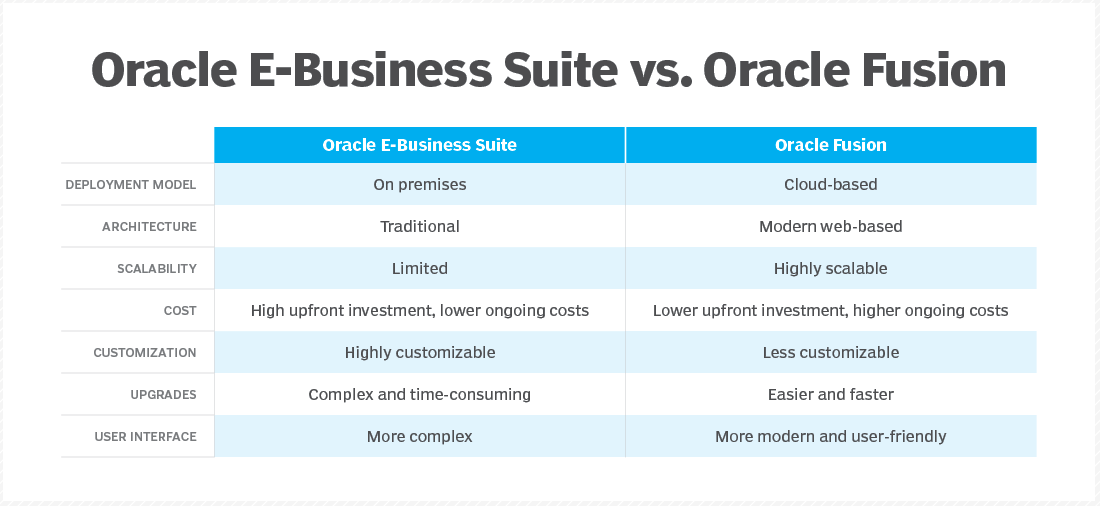
Oracle E-Business Suite and Oracle Fusion Applications are both enterprise application suites, but they are built with different architectures and deployment approaches.
Oracle E-Business Suite is primarily an on-premises solution with a traditional architecture that offers extensive customization and complete administrative control. It is well suited for organizations that require highly tailored business processes.
Oracle Fusion Applications, in contrast, is a cloud-based platform designed with modern technologies, providing improved flexibility, simplified maintenance, enhanced user experience, and easier scalability.
The right choice depends on an organization's existing infrastructure, business objectives, and digital transformation strategy. Companies seeking maximum customization often prefer Oracle E-Business Suite, while businesses looking for a modern cloud-first platform generally choose Oracle Fusion.
Implementing Oracle E-Business Suite
A successful Oracle E-Business Suite implementation typically follows several important phases.
-
Understand Business Requirements
Identify the business processes that will be managed through Oracle E-Business Suite. This helps determine the modules required, such as Finance, Human Resources, Supply Chain, Procurement, or Project Management.
-
Installation and Configuration
Install Oracle E-Business Suite either on-premises or in a cloud environment. Configure application modules, define workflows, customize forms and reports, and migrate existing business data while maintaining data accuracy and integrity.
-
System Integration
Integrate Oracle E-Business Suite with existing Oracle products, CRM platforms, third-party applications, and external databases to ensure seamless information flow across business systems.
-
User Access and Security
Create user accounts, assign responsibilities, and configure permissions. Since Oracle E-Business Suite offers numerous menus and features, users should be provided access only to the functions relevant to their specific roles.
Oracle E-Business Suite Training
Oracle provides various learning resources to help administrators, developers, consultants, and end users become proficient with Oracle E-Business Suite. These resources include instructor-led classroom training, online learning modules, official documentation, tutorials, and user guides designed for different experience levels.
Oracle E-Business Suite R12
Oracle E-Business Suite Release 12 (R12), introduced in 2012, delivered numerous enhancements aimed at improving productivity and collaboration. Major improvements included enhanced mobile support, better social collaboration features, and simplified integration with Oracle's cloud services.
Although Oracle has released newer updates and continues to evolve the platform, Oracle E-Business Suite R12 remains one of the most widely implemented versions across enterprises worldwide.
Oracle E-Business Suite Financials
Oracle E-Business Suite Financials is a comprehensive financial management solution that helps organizations manage accounting, reporting, compliance, and financial operations efficiently.
The Financials suite includes several specialized modules such as:
- General Ledger
- Accounts Payable
- Accounts Receivable
- Cash Management
- Fixed Assets
- Financial Reporting
Designed to support organizations of all sizes, Oracle E-Business Suite Financials improves financial accuracy, operational efficiency, regulatory compliance, and overall visibility into business performance.
Source : Tech Target